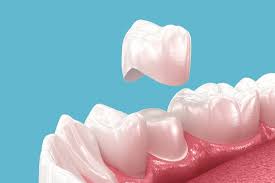
Dental restorations address issues stemming from tooth decay or trauma. Among the most common and effective restorations is the dental crown, which is a tooth-shaped cap placed over a damaged tooth. A crown covers the tooth to restore its shape, size, appearance, and strength. Here’s information on dental crowns and their benefits:
Restoring Function
Dental crowns preserve natural teeth by saving damaged or decayed teeth, preventing further deterioration. When a tooth is damaged by decay or a fracture, its ability to withstand the forces of chewing is compromised. A dental crown encases the entire visible portion of the tooth, distributing pressure evenly across its surface. This reinforcement allows individuals to bite and chew without risking further damage to the compromised tooth structure. Dental crowns act as protective shields, preserving the natural tooth while restoring its function. By covering a weak tooth, a crown can prevent it from breaking and hold together parts of a cracked tooth.
Preventing Bone Loss
When a tooth is lost, it not only affects oral function but can also lead to long-term consequences for overall health. The roots of your teeth stimulate the jawbone, and this regular stimulation signals the body to maintain jawbone density. If a tooth is lost, that stimulation ceases, which can lead to the gradual deterioration of the jawbone. A crown on its own does not replace a tooth root, but it can help preserve a natural tooth by encasing it. This protects teeth that might otherwise require an extraction.
By preserving the natural tooth and its root, a dental crown helps the jawbone continue to receive the necessary stimulation it needs. Crowns help the jawbone remain healthy and strong, thereby preventing bone resorption associated with tooth loss. This is especially valuable for individuals who have lost multiple teeth.
Combining With Other Restorations
Dental crowns are often used in conjunction with other restorative procedures to provide comprehensive solutions for complex dental issues. They serve as one component of many treatment plans, working with other restorations to achieve a stable, functional outcome. Here are some common ways crowns are utilized in dental restorations:
Root Canals and Dental Implants
Following a root canal procedure, a tooth can become brittle and more susceptible to fracture, so a dental crown is frequently placed over it for protection. In the case of dental implants, a crown is the final component attached to the abutment. The implant itself serves as an artificial root, and the crown functions as the replacement tooth. The crown provides a durable, natural-looking chewing surface for the artificial implant tooth root.
Dental Bridges
A dental bridge is a fixed restoration used to replace one or more missing teeth. Bridges work by joining an artificial tooth definitively to adjacent teeth or dental implants. Dental crowns are fundamental to this process. They are placed on the teeth on either side of the gap, and these crowned teeth act as anchors, or abutments, for the bridge. The artificial tooth is fused between these two crowns, effectively “bridging” the gap left by the missing tooth.
Learn About More Dental Crowns
Dental crowns are a versatile tool in restorative dentistry, and preserving natural teeth is a top priority for dental professionals. A crown restores the function and aesthetics of a single tooth, while supporting the broader structure and health of the entire mouth. To learn more about the benefits of dental crowns, contact a dentist for a restorative consultation. Find out if a dental crown or other restorative option can effectively improve your oral health.
About the author : Richard